

Weekly Biz Trivia - June 30, 2026
The business of selling an audience is older than the internet or television. On an August evening in 1922, a New York radio station called WEAF sold 10 minutes of airtime to a real estate company for $50 – roughly $1,000 adjusted for inflation. The company used the time to pitch apartments in Queens. AT&T, which owned the station, called the arrangement “toll broadcasting.” It was the first known sale of paid media on a broadcast medium. A century later, the same business model is intact, and only the targeting precision has changed. WEAF sold the attention of a city of strangers by the thousands. The apps sell your attention personally, by name, in the milliseconds before a video loads.
Before I drank the proverbial Substack kool-aid, I was reluctant to pay $8 a month for a newsletter. $96 per year is a nice dinner out. Paying that amount for information and content, a seemingly free and abundant resource, seemed counterintuitive. On top of that, I simply had too many subscriptions – Spotify, Youtube, Netflix, NY Times, and probably 8 or 9 others. Then I realized that the root cause wasn’t the dollar amount I was spending. It was subscription fatigue. Due to the sheer quantity of subscriptions I had, the psychological resistance to each marginal subscription compounded. Silly as this sounds, I think if I had 9 subscriptions at $5 each, I would have been far more reluctant to add a tenth at $5 than going from zero subscriptions straight to one at $75 a month – even though the latter cost me more.
But if everyone thinks like that, surely Substack wouldn’t exist in its form. We value Substack for creators whose perspectives we trust. Paying them is a way for us to signal that we believe in their work. In return, we ourselves grow. We gain know-how, we get inspired, and we walk away with newfound catharsis. There is a human realness and depth on Substack that’s hard to replicate elsewhere, and people are more than happy to pay a nominal monthly fee for it.
If the above sounded like a preachy sermon to you, I digress. So let’s shift gears and make this a pure numbers game, comparing the real cost of two options side-by-side. Holding content quality constant, which of these makes more fiscal sense?
$150 a year out-of-pocket for ad-free long-form content
$0 out-of-pocket for “free” ad-driven, mostly short-form content
To answer that, we need to put a price tag on your attention in these free apps: how many hours do you spend and how much is that time worth, in dollars? Spoiler alert – the free app costs you more.
We are not paying in dollars to be on social media, but rather with our time. I did my best to estimate the value of that time using two methods.
Method #1: your wage, in watch time
(If you reside outside of the US, bear with me, since my research is based on American data.)
Just as we pay taxes on our fiscal earnings, we pay taxes on our time. If you sleep for an average of 7 hours a night, that leaves you with 258 days’ worth of waking time to live your life each year. Besides time spent sleeping, the largest taxes we pay on our time is not at work, since we earn our keep from it. It’s our commute. The average American driver spends 230 hours commuting per year, or roughly 10 days.
If that number sounds high to you, then you should buckle up. The time you spend scrolling on social apps is unsurprisingly far greater than that, coming in at 2 hours and 16 minutes a day. For 18-24 year olds, that figure rises to over 3 hours. In other words, we’re spending over 1 full month’s worth of time per year scrolling feeds, or ~12% of our waking existence. In fairness, a lot of that time spent is genuine – messages from friends, a recipe, your cousin’s baby photos – so we’ll discount that.
What we do count toward our time tax, though, is the time spent consuming ads on these platforms. Studies put Instagram’s ad load somewhere around 20%, so let’s say about a fifth of your scrolling time is spent looking at ads. A fifth of 2 hours and 16 minutes is 27 minutes a day. That means over the course of a year, you’re spending 7 full days consuming ads. Imagine taping your eyelids open and spending every waking second watching ads for a week straight without sleeping. That’s some serious Black Mirror sh*t.
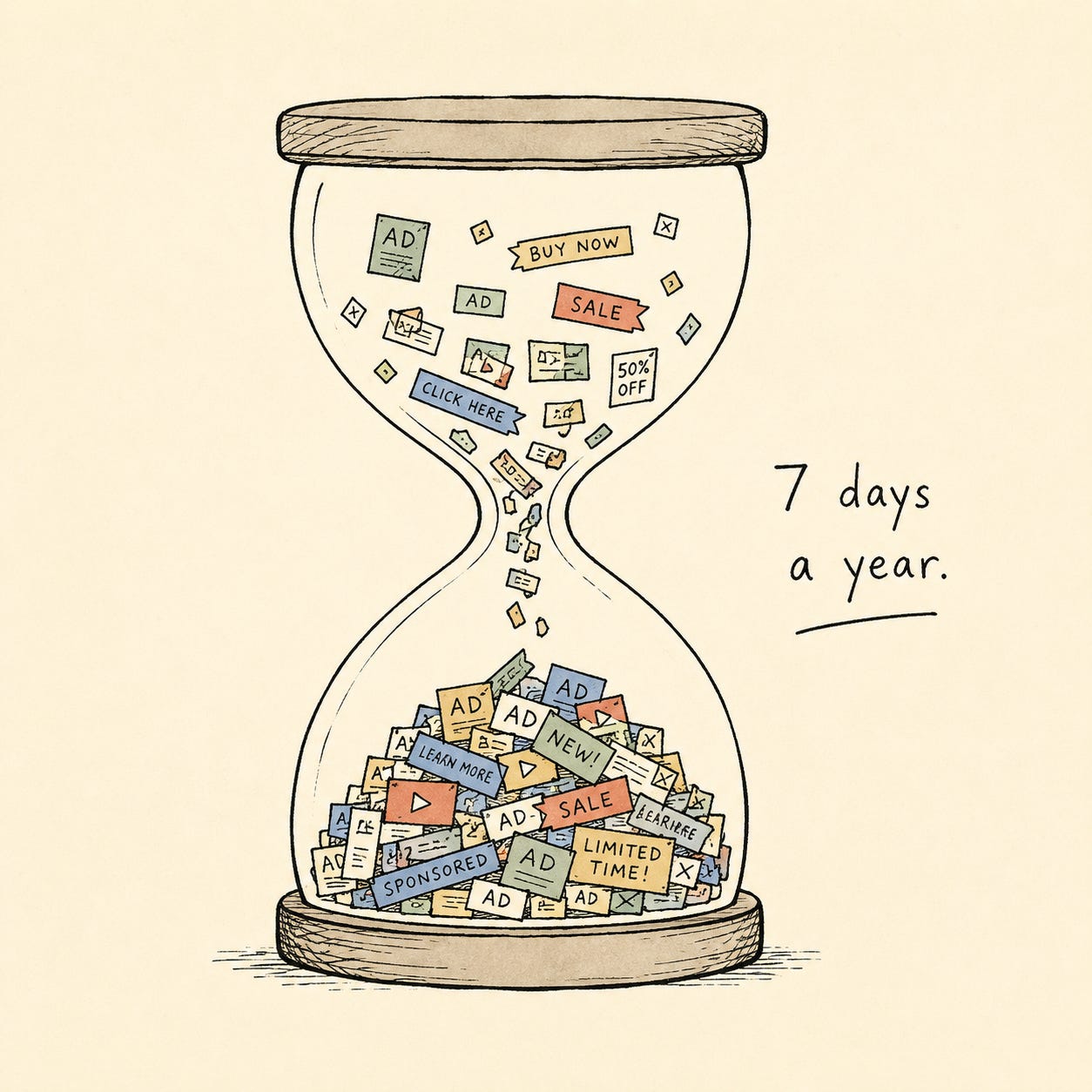
So how much time is that worth? We can estimate the upper bound using a the opportunity cost method. The average American earns $65,000 a year, which equates to about $31 an hour. At that rate, 164 hours comes to roughly $5,200 a year.
Of course, this isn’t literally what it’s costing you. The valuation is not realistic because it assumes the counterfactual of spending 100% that time working your job instead of watching ads. This opportunity cost could be more or less depending on what you would have spent those hours doing instead. But that’s a question only you can answer. 164 hours is a volunteering opportunity at your local shelter. It’s the many books you keep saying you don’t have time to read. It’s the Substack you put off starting. You have the time and you are spending it at the going rate, but instead of collecting a wage in dollars, know-how, or personal fulfillment – you’re collecting hits of dopamine.
The problem with the opportunity cost approach is that we can’t peg the value since it floats, and we’re inherently lousy appraisers of our own time. We price an hour at $200 the week work is on fire and at nothing the Sunday we’re bored on the couch. So while I can’t easily assign a monetary value of your personal opportunity cost of ad consumption, I consider it the price ceiling, the maximum unrealized value you could have earned from that time spent on something else.
However, the inverse is highly measurable. What you actually watched, bought, and spent time with has a trailing price history. The time you spent watching TikTok peptide unboxing reviews, the sense of envy you felt involuntarily brewing inside you as you scrolled past Insta reels of people living their best life traveling first class, or the 3am search query about whether your cat is plotting against you – has a specific price that is not set by you, but by advertisers bidding for it.
Method #2: Your eyeballs, at the buyer’s price
Thus far, we’ve only talked about the price ceiling, which is highly variable. The price floor of your attention, on the other hand, is concrete. We can turn to the advertisers who buy it for a living. Advertisers price your attention every day in live auctions, with bids happening millions of times a second. Since 99% of ad network traffic is powered by public companies, revenue figures must be published in the form of ARPU (average revenue per user). This data gives us a sense of what companies are willing to pay for your eyeballs. In 2024, Meta earned about $233 off every user in the US and Canada. TikTok made roughly $97 per American user and grew that figure more than 30% in a year. If you use both apps, your attention is valued by advertisers somewhere north of $330 a year. That number is the floor – the minimum your attention and its data trail is financially worth, as it’s what someone already pays for it on the open market.
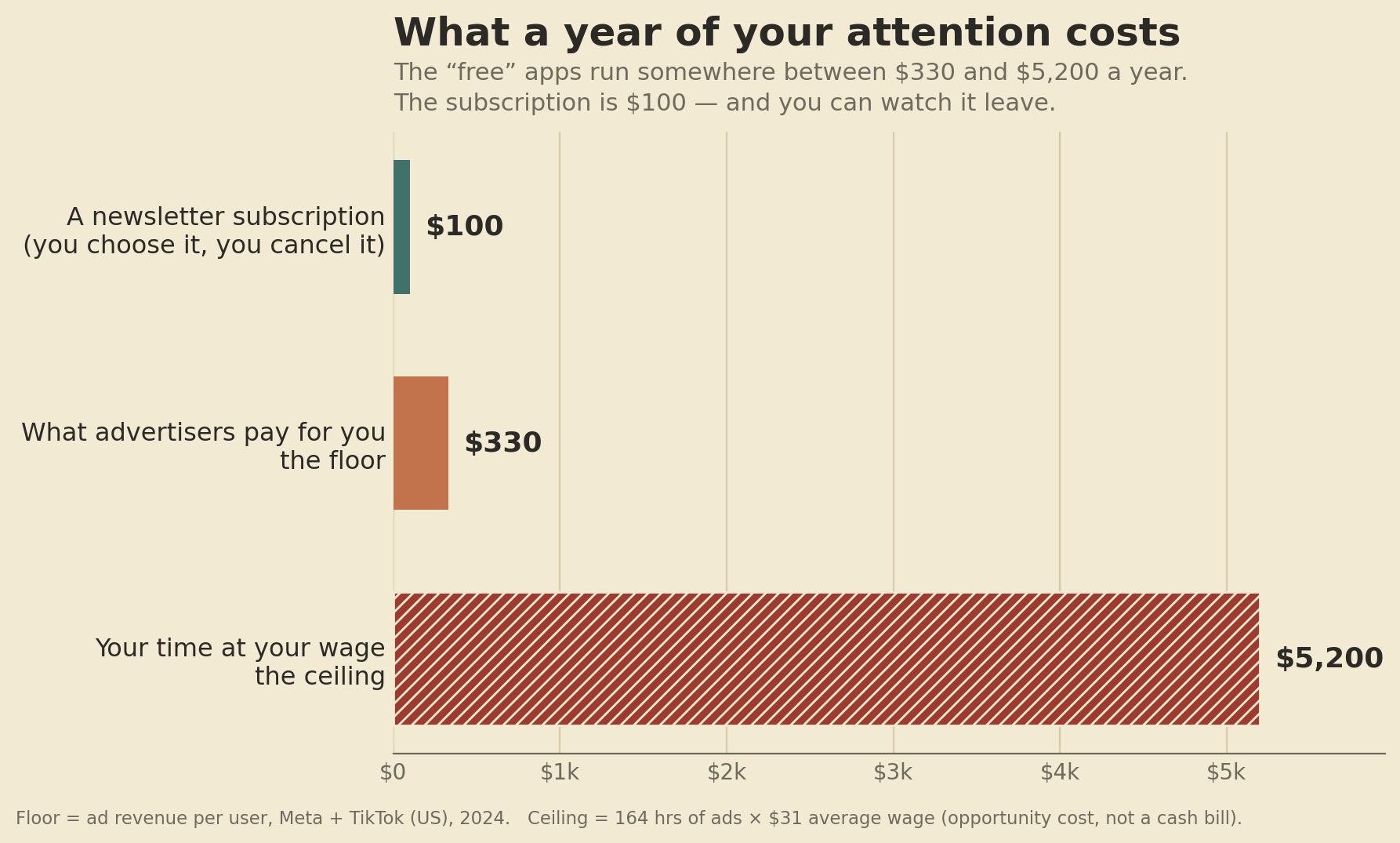
This leaves us with a price floor of $330 (the ad spend per user) and a $5,200 price ceiling (your personal opportunity cost) for our attention.
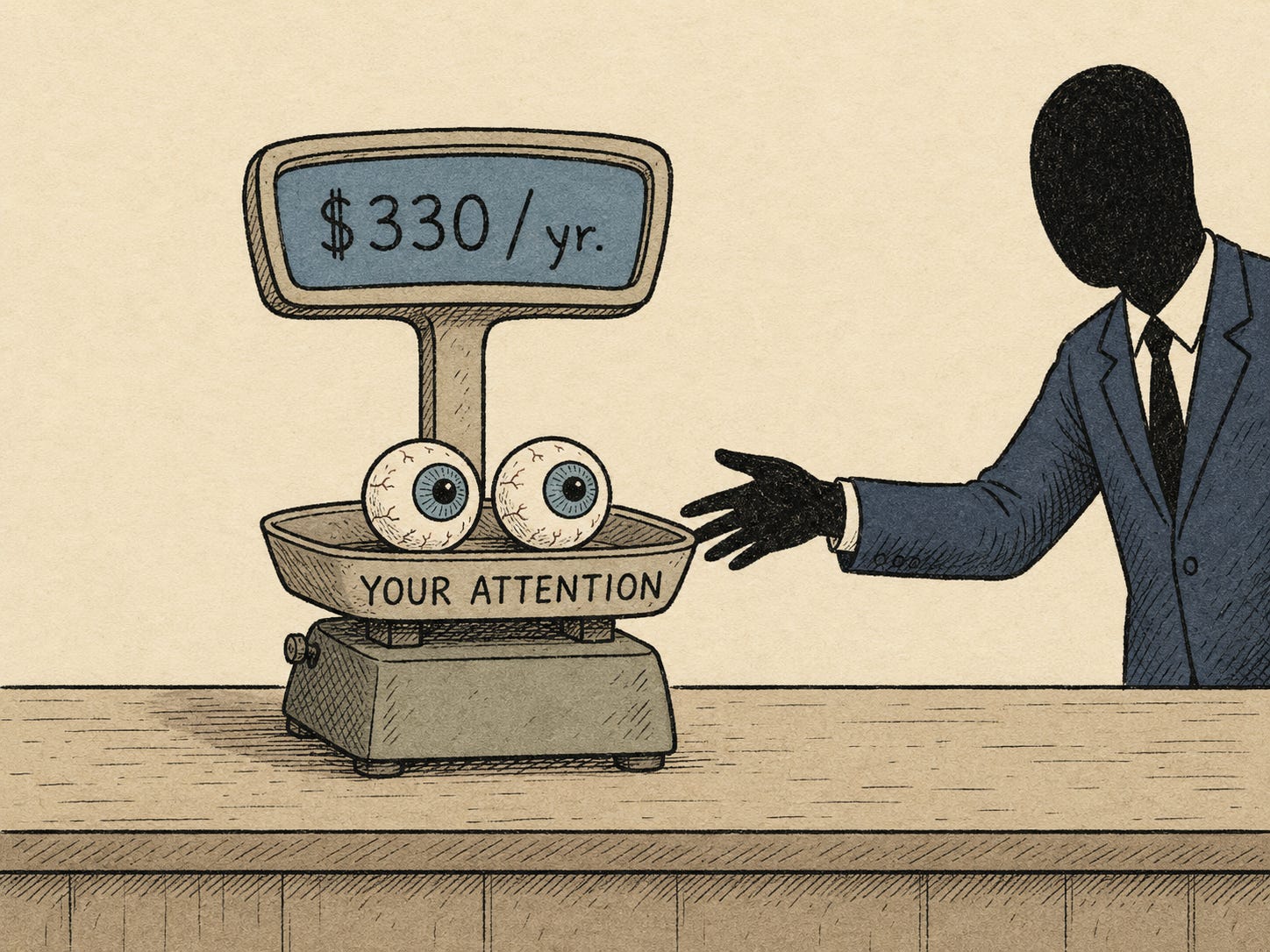
In reality, the real value sits somewhere in the range. So the next time you have “free” time and decide to open TikTok, Instagram, etc. – remember that the time you are about to spend on those platforms is not free to you, even if it doesn’t immediately deduct from your bank account. No matter how precise I try to be in measuring this cost, it’s still an underestimate, because I’ll never be able to put a number on the intrinsic value of having better mental health as a result of spending less time on these social platforms, which we know is an epidemic in and of itself.
Zooming back out, compare this to the aforementioned newsletter I hesitated to pay $96 a year for. That now sounds like a bargain by comparison. Even the advertisers’ $330 price floor is several times higher. So the free apps have been the more expensive habit all along, by a margin of at least threefold but likely much more than that.
But free is free! Nothing beats that.
In fairness, we’ve only talked about what’s sacrificed when you donate your attention to social platforms, without acknowledging what you gain. We do get something in return, and I don’t want to discount that. The friend two time zones away you would otherwise lose track of, the recipe found in eight seconds, or the small business that thrives because Instagram gave them a platform. That’s real value, so I’m not here admonishing the use of social media as a whole. What I’m advocating for, instead, is moderation.
In a University of Chicago experiment, the average student wanted to be paid $59 to give up TikTok for a month and $47 to give up Instagram. Those figures measure the cost of one person leaving independently, with one major underlying assumption: everyone else stays. What that creates is FOMO, a powerful psychological force that in which people feel the need to be compensated to avoid having it.
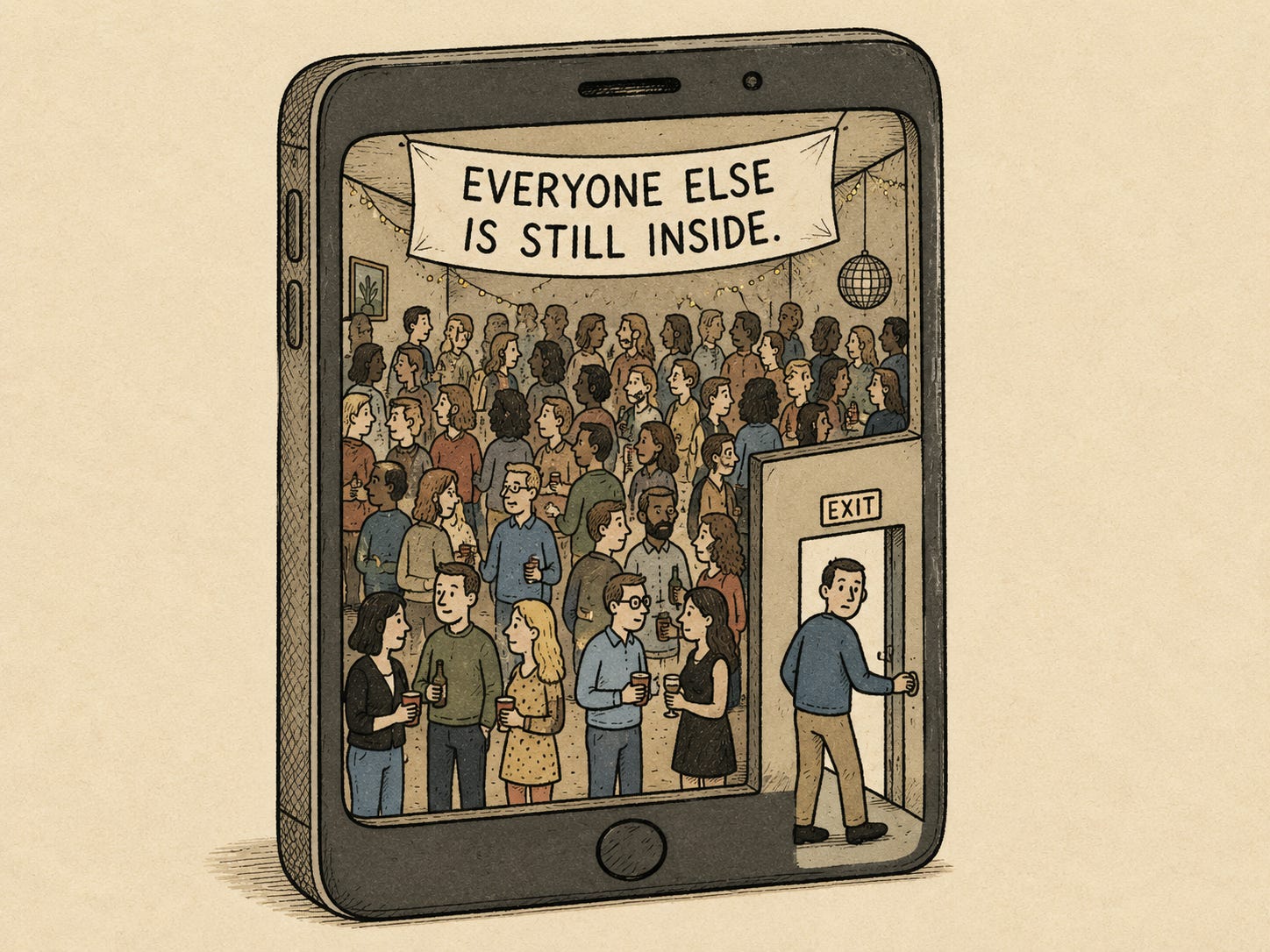
This number, however, says little about how much anyone actually enjoys staying. The $47 buys back your access inside the room, but it has almost nothing to do with how much you like being in the room. In other words, quitting while everyone else sticks around means you miss out on the latest trend, you’re no longer in on the joke, and you slowly fade into the background.
But what if we asked the same question again, except this time, everyone else quit social media along with you? It turns out that instead of demanding money to quit, people would offer money to quit: about $28 to be rid of TikTok, $10 for Instagram. When the party gets canceled for the entire campus, no one is afraid of missing it. The same study found that 64% of TikTok users and 48% of Instagram users are better off in a world where the product does not exist. The authors called the pattern a “product market trap”: a platform that large swaths of its own users would pay to abolish, kept alive only because no one can afford to be the first to leave.
That changes the whole narrative. The payment you demand to quit is not a measure of what your attention is worth to you. Rather, it’s the cost of being the only one to walk out while the party goes on. Paradoxically, the platform you’re getting for free is something that everyone would pay to be rid of, if only they could all leave at once. From that lens, describing it as “free” is quite a stretch.
The thing with a price tag is the cheaper one
A subscription is a no-frills way to measure the value of your attention because it’s entirely at your discretion. You are empowered to spend $8 a month to support a writer of your choosing, and withdraw that support the instant you decide it’s not worth keeping. There’s no meter running in the background tracking your impressions and selling that data to advertisers. Once your credit card clears, the transaction ends, and from then on, it’s up to the creator to earn your next monthly renewal.
A “free” social app is built the other way around, ultimately creating perverse incentives. The longer it keeps you hooked, the more money it makes. This is why there’s a devolution to shorter form content, rage-bait, and slop – it’s total red meat for maximizing your time spent, exacerbated by UX patterns like bottomless scrolling and autoplaying the next video before you have decided to watch it. The creator charging you $8 makes the same $8 whether you read for 60 seconds or 60 minutes. Their goal is not to keep you addicted, but to give you a rewarding enough experience to renew.
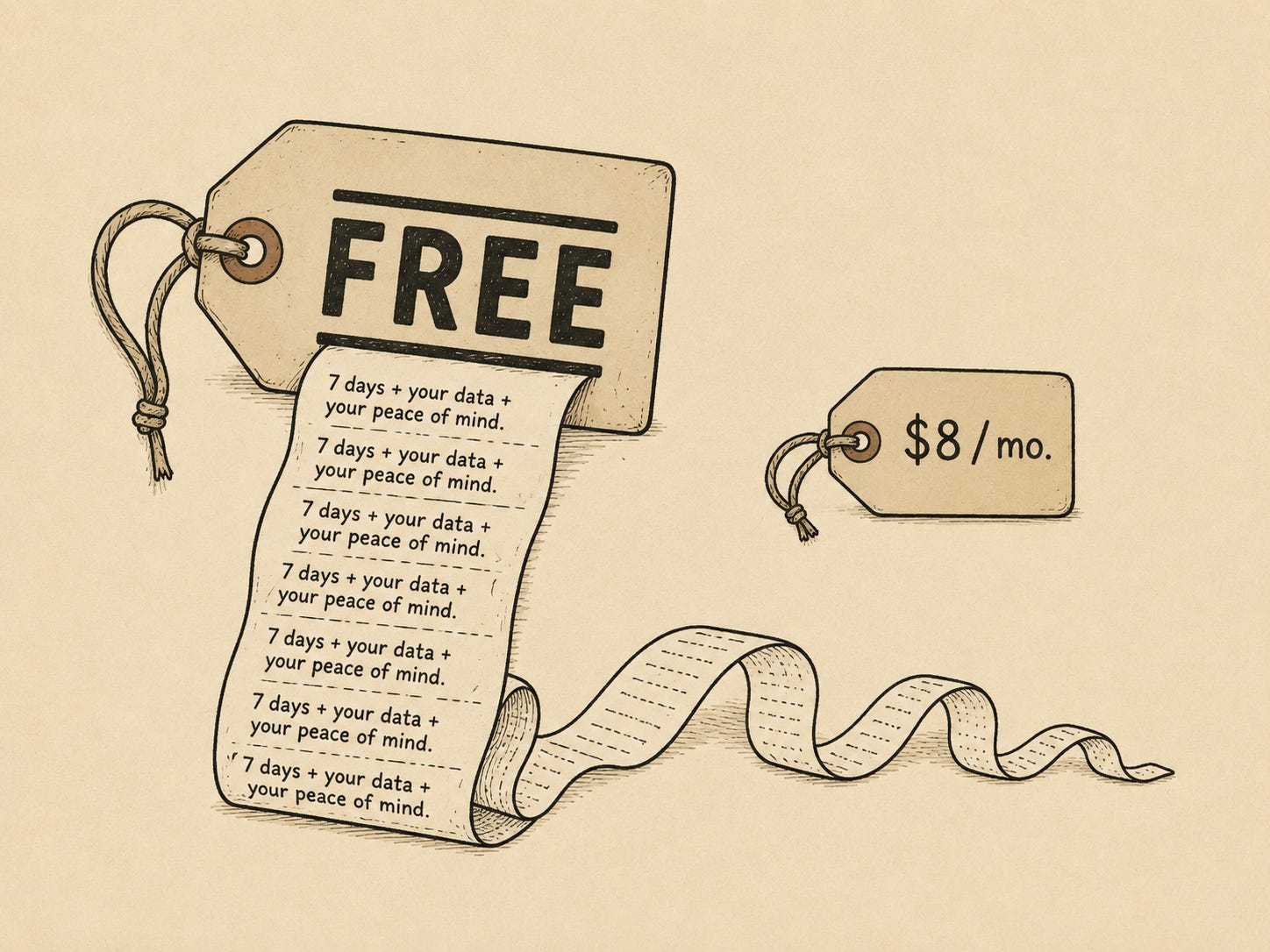
While the couple of subscriptions that cost $50 to $100 a year are real dollars that you see leaving your bank account, the arithmetic shows that it’s a mere fraction of the attention time meter alone. You could pay a dozen of your favorite writers directly and still spend less than the week of waking life you currently hand to advertisers for free.
To add insult to injury, platforms whose businesses were built on ads are now charging subscriptions in their own right. For anywhere between $3 and $40 a month, you unlock freemium access to features on Meta Plus, X Premium, etc. – all whilst having a zero reduction in ad load.
This further tilts the math in favor of the direct creator-to-consumer subscription model. The free platforms are now billing you in real dollars while giving you none of your time back.
Time is Money. Spend it Well.
I’m not arguing in favor of defenestrating your phone, packing up, and moving to the woods (though that does sound nice right now, doesn’t it?). The point is more nuanced: be more cognizant about what you are spending, and in what currency. Time? Money? Both? Then, spend more of it with intentionality. A few things that have worked on me:
Put a dollar value on your hour. This isn’t your wage per se, but the amount you would pay to buy an hour back. Until that number exists, everything that gives the illusion of being free continues to feel that way.
Audit your screen time for a week. Look at your screen time on social apps in your phone’s settings. Divide that number by 5 to derive the social hours for ads, then look up what your most-used app earns per user. That app has officially priced your attention more carefully than you ever have. It’s time flip the script.
Redirect those hours to something with a visible price. Maybe that’s 20 minutes a day spent reading a newsletter or a book, or watching a person whose work teaches you something. You’re not actually spending more money. It’s just the spending became more legible.
Transact with creators directly for their work. When something earns your attention, send a few dollars to whoever made it. It directly funds the work that you found edifying, aligns incentives cleanly, and it still costs less than the attention meter you’ve been feeding elsewhere.
By the way, if you smell hypocrisy, you are not entirely wrong. I’m an avid user of social apps and like many of you, I will likely open one within the hour. The difference I am after is smaller, and mostly in my own head. I wrote this piece to become more intentional about what I am spending – time, money, or both – and roughly how much, and on what.
I don’t think social apps are a scam, and again, I’m not advocating for their abandonment. They’re hard to quit for a good reason: everyone you know is already on them, and walking away costs something that never shows up in a quantifiable manner.
So as always, I’ll leave you with one question. Open your screen time, find your daily social media average, and divide it by 5. That’s roughly how many minutes a day you’re spending on ads alone. Multiply that by 365. Now ask yourself: what would you pay to get that time back?
Whatever number you just landed on is the minimum your attention is worth. And it’s yours to spend however you want: a book, a newsletter, a side project, or perhaps a slower morning. The point isn’t necessarily what you spend it on. It’s that you’re now more acutely aware of that fact that you are spending it in the first place, you have the power to decide where it goes.
ChenStack is free, and the weekly essay always will be. Each issue takes real hours outside my day job: research, interviews, and a concerning amount of staring at the ceiling. If you’ve gotten something out of it, you can pledge your support. It’s free and just tells me you’d back a paid tier if I ever spin one up. If enough of you do, the paid side would be the fun stuff: company teardowns, actionable advice creators, PMs, and founders, and a direct line to ask me about whatever you’re working on.
I'm absolutely in love with this approach. What a legend, Chris.
No i didn't. I don't watch ads. Except rarely meme ones.